October 15 - December 15 every year

A'o (ah-oh) - care for them
The electric company on Kauai has taken huge steps toward remedying the situation with info and recommendations about the shape of hoods for lights and the county has even eliminated night sporting events during the critical months. Never the less, birds continue to fall victim to electricity. Even during moonlit nights any bird can hit the high wires and this may cause more the stun of falling to the ground, often neurological damage or death.
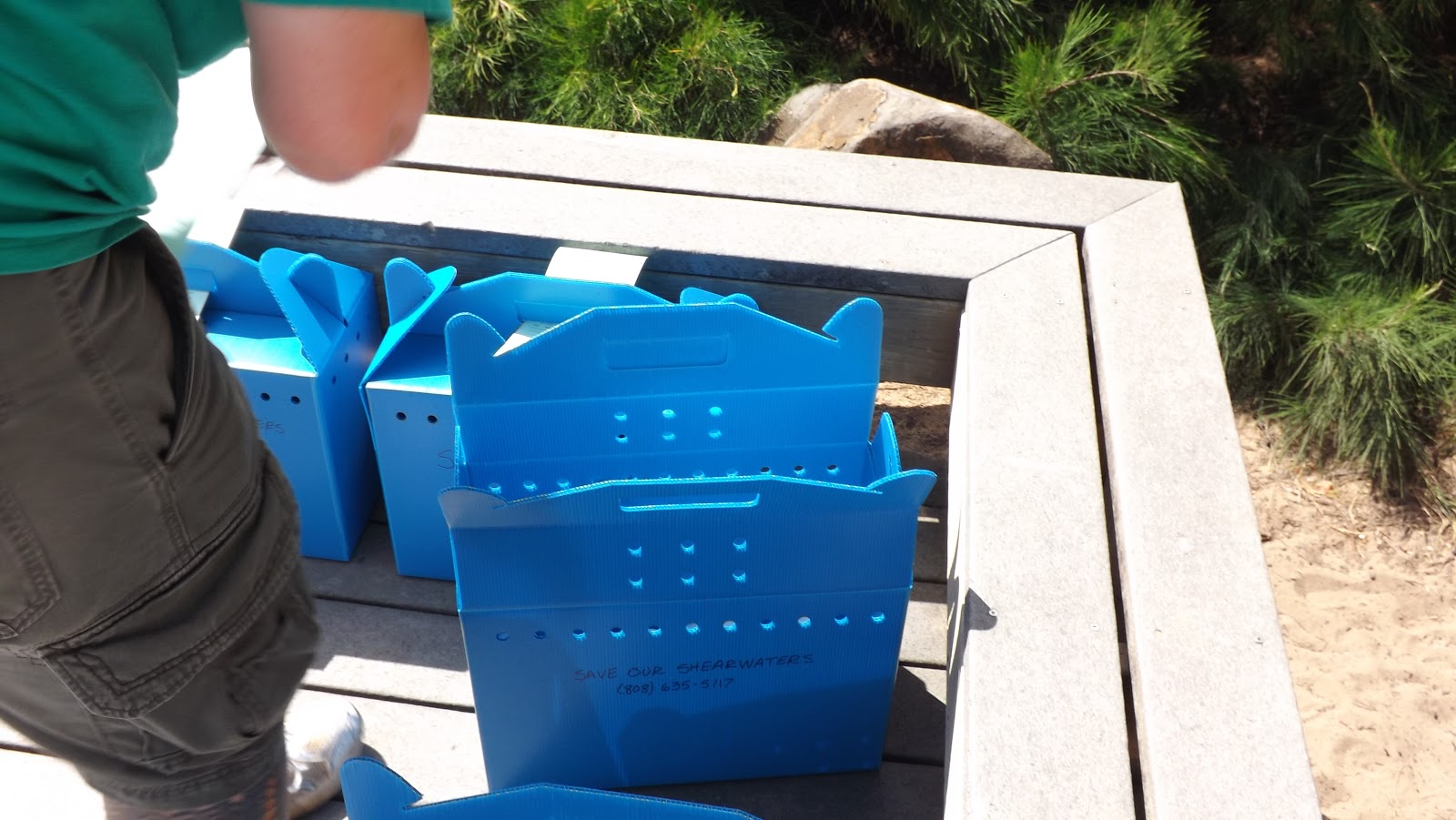
SOS or Save Our Shearwaters was started some years ago to recruit the public to help the birds. There are stations all over the island where birds can be placed if someone finds them downed during the night. Most of us carry cardboard boxes and towels in our car to pick them up and transport them to a station. The stations are checked daily.

Princeville Firehouse station
A card is filled out at the point of pick up for each bird and placed with the box the bird is placed in for transport. I travelled along with Marilou Knight for pick ups between Hanalei and the Humane Society in Puhi just past Lihue. Hanalei, Princeville Fire Station, the St. Regis hotel, then the medical clinic in Kilauea and fire stations in Kealia, Kapaa, Lihue, the airport and the harbor. Lydgate Park is the release location for all of these birds.
Marilou opens each crate, one at a time and does an assessment on the bird with careful notation. The wings are checked for broken bones, rotating each joint. The keel or breastbone/chest area is checked for fleshiness to determine if a bird is undernourished. Notes are made regarding the feathers being frayed. Eyes and mouth are checked for hydration levels. Wing length is measured and weight taken. Each bird picked up is examined in this manner and banded. Just like albatross or koloa ducks (mentioned in earlier posts) the band number is kept in a data base with international access.

Keel check: if fleshy at breast, good indication it is a healthy bird

Wing length

Weight - bird is placed in a thin fabric bag - burrow birds are less stressed when enclosed

Banding for international data base
anyone who ever encounters this bird can find out where it was banded

Coated cardboard carriers with data sheets
If the bird seems healthy in all regards, it is placed back in the carrier and put aside for release.

Placed on bench about 10 feet above sand and open ocean ahead

Didn't take him long to decide, up, up and away!

This is number 328 and was picked up last night, while he seemed healthy,
he took off but landed in the sand; after three attempts, he was taken in for rehab
Getting the next one up for the tarmac, he hesitated quite a while but had a beautiful take off
His hesitation made the video I got too big to download!
His hesitation made the video I got too big to download!
This next one did well.

A quick look around, felt the wind and took off

There he goes! SOS success

Gil Donnelly photo
The ocean is true Shearwater country
Gil went fishing and once at sea, the boat was surrounded by boobies, noddies, and shearwaters out there earning a living. Getting caught up in the drama caused by humans (lighting) is a major interruption to their normal activities. Helping to get them up and back on track is the least we can do.

Humane Society
For the birds deemed in need of rehabilitation, they are taken to the SOS headquarters at the Kauai Humane Society. This facility is phenomenal. There is both an outdoor portion and an indoor lab as well as a sanitation room - like a hospital ward. Each bird brought in is hydrated (tube down the throat with 25cc of water laced with nutrients) and further assessed for best treatment: hydration, nutrition and frequency, meds, pool therapy, need for exray, etc. A feeding schedule is determined - some get whole fish - this would be smelt, some get a slurry of smelt and other nutrients via a tube. Like any hospital, this a 24/7 operation and the hours are long - for three months.Between feedings and other interaction, the birds are placed in hard plastic cubies fitted with plexiglass slide doors with ventilation holes. A towel is placed loosely over this as these little burrow guys do not need the stress of colorful activity around them - they need rest.

Cubies - washed and sanitized between all procedures as is the entire room

One of several charts
See #328, line 4, possible fractured coracoid, due for Xray
Rather than using endless latex gloves, each bird is handled in a small towel. This also has the advantage of holding their wings in which is calming. The towels are only used once and thrown into a colored laundry basket. when it is full someone takes it to the energy efficient washer dedicated to the rehab (not shared with dog and cat hair of the neighboring facility within the Humane Society).

Clean linens on hand from wash rags to sheets, much of it donated by the caring public
Color baskets for dirty, white for clean, whoever has a free moment, keeps it rotating
Sometimes the birds land in red dirt or in oily locations like the road or a parking lot. They will need a wash. The mechanism they have for being water tight is interlocking feathers. If these cannot lock due to dirt, they will not survive on open water. If anything on them is toxic, they could ingest it while preening. It is a misconception that they oil their own feathers for waterproofing. The gland that is active during their preening is actually a nutrient rich conditioner for the feathers. They use their bill to correctly align the feathers and that keeps them dry at skin level.
The call of the Newell's Shearwater (NESH in scientific terms) is a surprise. It is either like a braying donkey or like a baby doll with a pull string. (See March post on my night vision escapade waiting for NESH to arrive at their burrow for nesting). In this video of a bird getting washed, the call is plain! It was put in a dryer pen directly after being bathed so it could dry quickly. The pen has a mesh bottom and a pet dryer is place underneath, blowing diffused air into the pen.

Drying pen - a chance to groom his feathers into water tight lock again
Frayed tail feathers noted
.JPG)
Also in the drying pen,
Note this guy has 2-3 smelt in front of him - he likely spit them out when no one was looking
They are given ~8 of these twice a day plus whatever other nutrition is scheduled for them

I happened to catch these two workers in the office entering data, not a hydration syringe or smelt in sight.

Emily Pollom & Bethany Spiegel

The outdoor rehab area has Pool A (front) and Pool B directly behind it
At right are two drying pens (see pet dryer under front one in use)
right back is the smaller round Pool C
John & Marilou are observing birds in Pool A while Emily is checking out Pool B
John & Marilou are observing birds in Pool A while Emily is checking out Pool B

This guy seems to be having a blast swimming, ducking and popping up -
practicing maneuvers for the sea. He is due for release tomorrow
practicing maneuvers for the sea. He is due for release tomorrow
Sometimes it is unknown how long rehab will take and not all birds will get released

This is an adult (#181 line 2 on chart above)
He was probably caught in high wires before falling
One leg is paralyzed and he is scheduled to swim as much as possible
He is able to negotiate himself on and off of this mesh float with the other leg and his wings
Not all the birds at the facility are Newell's. There are a couple Wedgetail Shearwaters (WTSH) too, another burrow bird. And there will be more as those chicks fledge slightly after the Newell's. One of the biggest differences is that when wedgies bite, it hurts! There are also a couple White Tail Tropic Birds (WTTB) and even a baby Hawaiian Coot raised from an egg!

Whitetail Tropic Bird being fed

Baby Hawaiian Coot, with a mirror for company

I prepared his food today - kale, broccoli, papaya, seeds (looks alot like my lunch)
and smelt and worms (not so much)
He is due for release in Hanalei refuge, another task of the field tech
YOU CAN HELP
Keep a cardboard box in your car and a towel, place bird in the closest station and call it in
If you have time, especially during new moons, spend a lovely day in Puhi scrubbing!
Just as a follow up, I was asked to sew up some tubing and turn it into booties for the birds. In rehab they sometimes developed sores on their feet. To prevent it, their feet were wrapped in surgical tape - a time consuming and costly intervention. Purchased booties were too short. If they had really known my sewing skills I would not have been called upon for this task. A good friend loaned me a sewing machine capable of handling the stretchy fabric. The tubing made 11 dozen booties!

Dozens of booties for Newell's Shearwaters
I asked how they worked out a few weeks later. One clever little bird managed to pull a thread loose from the top edge and worked it until it was totally entangled and threatening to cut off circulation! Not all of the human solutions make it through testing.