JUNE - ALL ABOUT FISH


JUNE 2012
I went fishing!  We had high winds and too much surf to go out for a while so I contented myself with revamping my garden pond.  It had attracted some ugly black algae that was supposed to cycle itself out but didn’t so I emptied the pot after catching all the platys – tricky little buggers!  I repotted the water lilies and rush, got new tape grass, Gil repaired a leak and we refilled.  

Platys waiting for the remodel on their pond

Since it takes a while for the new water to release its chemicals and mix with the old pond water, the platys were house guests for about 48 hours.  
TO BE CONTINUED . . .

Here are the guys back in their home a few weeks later:

Everyone seems to be healthy and happy - no more black alage


BACK IN THE OCEAN!
            Maybe because summer has come to the north shore and maybe because I'm meeting so many people who really care about the ocean, I'm now involved in contributing to data bases that catalog what is happening on the reef.

Reef surveys:  
Reef:org   
ReefCheck 
Eyes on the Reef


So, June means back in the water on the North Shore, YEAH!  I have been submitting "roving" reef surveys to REEF.org for a year now which is all about fish - their survey form for Hawaii has over 200 species listed and I indicate which ones I see at which coordinates during what time span, what depth, etc. 
Now I am also the official reef surveyor for my friends’ ocean eco-tour company.  The visitors that go out with Malama ke Kai (take care of the ocean) learn to recognize the fish before going out, go see what is there and then come in and discuss what they saw.   (see friends and links)
While the data I submit is my eyes only, I get to help the visitors identify what critters they got to see when we come in.  It is a sort of game where they describe a fish to me and I try to figure it out, find it in their guide book and they confirm what they saw.  My success rate is pretty high so far but a lot depends on how good their descriptive powers are, not to mention their memory.  What great fun – many, if not most, have never snorkeled before.  Of course seeing a turtle is always a BIG hit.  
MKK’s agenda is that people will still be excited about the environment when they get home and make personal life changes toward a better planet from their back yard. 
The Princeville reef where these eco tours are taken is one I normally do not swim at so I checked it out prior to my first group encounter.  Some fish are abundant and can be seen anytime, anywhere but around every bend in this coastline, some different fish reside; they have their neighborhoods.
For instance I see lots of Ring Tail Surgeonfish on the south side, up close and personal.  On the north shore they aren’t as frequent – or hadn’t been.  So, I was surprised to run into this whole school of ringtails.

Predominately Ringtails, a few White Bar Surgeonfish
In any big group there are a few clandestine strays that like to travel in the crowd

Part of the deal with Ringtails is distinguishing one from another. They don’t always exhibit their rings, they all have a little yellow at the eye but how much?  And is the scalpel near their tail black or white? That's the little blade that makes them "surgeons."
Then there is the pectoral fin, the ones they swim with.  Yellow fin Surgeonfish are supposed to be rare here but I see them all the time.  If the scalpel is white, it is an Eyestripe Surgeonfish (more yellow at the eye).  Just too fun and if I can get a picture it helps me distinguish later. 
 
These are Yellowfin Ringtail Surgeonfish - the yellow pect fin is the give away
This shot is fun because they don't always display that dorsal fin
See how sleek they are in the freeway photo above?


Snowflakes in June
So the other story of the day was on the return to shore I spotted a Snowflake Eel.  On closer look I realized there were two.  One was trying to enter a hole the other was already occupying.  A good sized Christmas Wrasse was hoping they would scare up something he could eat so he fluttered nearby.  

         Apparently the movie button did not engage on the camera so the whole 
eel scuffle with pushing and biting I thought I recorded ended up being this one shot

One eel finally won and I saw the Christmas Wrasse shoot out about ten feet below me,  sure enough the loser eel was scooting along the sand looking for a new hidey-hole as well.


June 8
Oceans Day was celebrated this year by reviving ReefCheck, a project started a long time ago but not conducted for the last three years.  Training for this process was one evening to learn the system.  It included an intro to coral which I know very little about.  
The next evening was a training class called “Eyes on the Reef” which encourages reports of damaging algae blooms, excess species that could do harm whether natural or invasive.  This too, included an intro to coral types and what coral damage looks like.
The surveys for ReefCheck are done by setting up a transect line in the ocean, actually two – one for snorkelers and one for scuba guys. 


Snorkelers have it easy.  Scuba guys need suits, tanks, regulators, etc.
We all used the underwater clipboards to list either fish, invertebrates, or substrate
Buoys marked the starting point of the transect lines and their GPS coordinates were taken

Malama na 'Apapa is the sponsoring group - it means caring for the reefs
What a gorgeous Oceans Day
            
One team swims the line - an area 5 meters in every direction - looking for specific indicator fish and marks them on an underwater clipboard.  The next team swims the line marking invertebrates like urchins and crabs.  After the next interval, a single surveyor records points along the line for substrate or ocean floor.  The joke was last time out the substrate surveyor had sand at each marker!  Not this time, this is a great coral reef.


Transect Line for snorkel team 

            On the way in we all saw this school of convict tangs trying to eat while the lavender tangs and one black spot sergeant try to scare them away from their personal feeding ground.  Very entertaining.


MAY CONTINUES ON KAUAI


Mid-May
            While I was cruising ancient seabeds in Colorado, Gil was entertaining friends Cliff & Nora from California.  At Pali ke Kua, where we go turtling, he tried out his new camera mask.  

Gil's Honu


            Back home myself, I had to check out the flat, clear water I had heard about and took our friends to Sealodge reef.  The tide wasn’t due to peak until 6:30 so we went out at 5pm to have a little light.  So shallow here it serves as a nursery for fish.

These little Gray Chubs with black lined tail fins are only the size of the 6"
Black Spot Damsel fish on right 


These 2" baby Hawaiian Flagtails were between rocks at the shoreline. 
I also saw a dozen full edible sized ones hiding in a cave about 100 yards off shore


Friends Cliff and Nora spotted this large lizard fish with his un-fish like behavior,
sitting still in one place, long enough for me to swim over to see it too  
 Slender Lizardfish waiting for dinner to come by, not quite as camouflaged as he thought

Blue lined Butterflyfish, grazing or posing for the camera?

 Before we left, we spotted Gil and the Namo guys offshore
after their run up to the Lighthouse in six-man canoes
 Three canoes go by Sealodge Reef,
two of them centered in front of the squall that found all of us!

MAY IS MOTHER'S DAY


            A quick trip to Colorado isn’t very oceantic, or is it?  Turns out that as I traveled to the western slope and visited the Black Canyon of the Gunnison National Park, I was witnessing the ocean floor of 525 billion years ago, when this region was not only "down under" the water but also still in the southern hemisphere.  Now, I’ve been doing the geological research of the Hawaiian islands and thought I’d been dealing with deep time – silly me.   But further research into the heart of the mainland will have to wait.

 Black Canyon of the Gunnison near present-day Montrose, Colorado  
A deep gash 48 miles long


Looking at rock that was part of the sea floor 525 billion years ago, 
the Gunnison River continues to flow for now


The blessing of a rainbow following a quick rain shower

            The purpose of the trip, of course was to see Mama and here she is – 96 and giving everyone a run for their money, even Hospice.

Surprised to see me in the morning

 By afternoon she was ready for the road


  Others were celebrating Mother's Day as well
A Canada Goose and her goslings

APRIL ON THE GROUND


So what else has happened in April to leave me out of breath but full of gratitude?  Bird listening with night vision glasses.  WHAT? 
Conscious people living on Kauai are aware of the Newell’s shearwater – a lovely little bird that cannot adapt to the human invention of electricity.  They breed in the mountains and should fledge during the full moon – their eons old instinct tells them to fly to the moon and in doing that, they are transported out over the ocean during the night.  Instead, they head for any light source they see – especially light posts – and circle it until they fall out of the sky.  They haven’t had time to unlearn this dangerous habit. 
Our electric company, which is the source of much controversy due to the highest rates in the US for electricity, does have a program called Save our Shearwaters that at least advertises the risk of sky facing lights.  Both night time ball games and car racing have been curtailed due to the situation – much to the chagrin of players, parents, and all sports and racing enthusiasts. 
Obviously the birds are endangered with a population decrease of 75% from 1993-2008.   One of the solutions has been to literally move the eggs to a more convenient fledging location, like the Kilauea Point Wildlife Refuge.  This has worked for a few birds.  The second method has been to play the sounds of the Newell’s during the night to attract others to breed in the safe environment that is already home to the Wedge-tailed shearwater. 
So, on the evening of April 19th, having listened to the jackass-like braying calls of the Newell’s from a computer, I sat in the dark in a known nesting sight – waiting to hear them.  It was a superb night without rain and I was in a relatively wind-free location.  I was supplied with a pair of night vision goggles and a seat with a back so I could comfortably sit on the ground.  The requirement was that I be quiet and fairly still.  I loved it.  According to the web cam, a Newell did show up and enter his/her nest and spend the night a few yards from me – without a peep (or bray).
            What was incredible was how many stars show up in the military type night vision goggles.  The stars visible with the naked eye become huge bright orbs while in between – in the darkness – are a zillion more light points.  The plants are lit from within, they seem to glow.  


                                                                     Vision quest 
I went back a couple days later and took this daylight shot from my vigil seat – not the same . . .


            My other adventure with the refuge folks was to go along with ten third grade students from a charter school that have been studying Albatross all year.
We met them at the overlook and they did a long Hawaiian chant for permission to enter.  Chicken skin.

The kids chanted as we overlooked the point - asking permission to enter


 Red Footed Bobby on nest below the lookout
Seems the chant was acceptable


Using the spotter to see Alabatross Hill, Caroline Tucker presiding
For some of the kids these were the first sightings even though they have studied them all year

This was their field trip to see the birds first hand.  They also got to experience the Wedge tailed Shearwaters that are here nest building – normally at sea all day (like the Newell’s and like the Bonin petrels we met on Midway in December). 

 From lecture to reality, this shearwater was digging further into the burrow
Class and teacher, Malia, watch


Three more wedgies in the roots of a nau paka


Out on the point, the tropic birds were doing their squawky mating calls
and showing off for everyone.

 Red-tail Tropic birds

           The second part of their field trip (and mine) was Crater Hill, only available with Refuge personnel.   The kids were great – we met many Red-foot boobies up there who are also in the nest building process.


Male boobies bring nesting material to the females for placement
These birds are three years old before they have the full colors exhibited here


The kids from Kanuikapono charter school in Anahola, really enjoyed this outing
Snack outside of refuge on Crater Hill

There were a few whale spouts out among the whitecaps on the very windy sea but the kids were focused on the birds and chasing each other around with tufts of weeds they had picked.  After all they are in third grade.

APRIL BY SEA

I got in five snorkels this month which is really good considering April still has winter waves that create no-snorkel zones.  With friend Marion, we couldn't resist going in the water at this shallow reef area we hiked down to – it was so silly to be in water a few inches deep but I was at least rewarded with a yellow margin eel.  

Yellow margin eel

            On the way back we stopped in to see how much this albatross chick has grown – feathers are getting full under the down.

This is the same little guy that had his wings out in a previous post.


The same day we played around at Lumahai beach while the guys went paddling

Lumahai - always misty here


Not a monk seal, this is Marion at her favorite beach


Three canoes upper left, Gil and the Namo guys at practice off Lumahai

            I went snorkeling with Steve Cole and Jane Dulaney that run Malama Ke Kai and I will also be doing reef surveys for their eco-tours this summer.  What a hoot, the group they took out were mostly Canadians that had never snorkeled before.  We were in 4 foot surf and they were game!  I’m not used to watching humans in the water – I took photos using the MKK camera and my mask camera was acting up – none to share. 
Of all the exciting things going on in the water, however, the best was seeing a rather large Blue Goatfish impersonating two medium sized Jacks, or Bluefin Trevally – all about 18-20”.  They were exhibiting mutualism – that is travelling together for mutual benefit.  Just another quirky habit fish have.  It required a double-take and then a triple-take to identify the impersonator – I’d never seen one that large, in fact the jacks I see in there are usually 8-10" juveniles.
Please see Susan Scott’s 4/2 Ocean Watch article and then follow up with her 4/16 article.  This is why we love her – not afraid to keep learning.  (susanscott.net/ocean watch).  I hadn’t read her articles until after I submitted my survey to Reef.org – doubly excited to be on the same page or in the same ocean with someone I so very much admire.

APRIL BY AIR


My March blog showed up in April, and now April is showing up in May, sorry.  I would fix it if I was a little more geeky.

APRIL FROM THE AIR - HAPPY BIRTHDAY GIL
            For Gil’s birthday we took a flight around the island in a small fixed wing plane.  Our Friend Marion was here from Seattle and joined us.  Getting to see the Na Pali from the water recently and now again by air, Yipee!  It takes the sting out of getting older.   

            The island is very wet and is still breathing mist into the air as all the photos reflect.  We tend to edit with our eyes and interpret what we see, but the camera doesn't filter the air.  The sun and clouds played hide and seek, April is always sketchy.

Nawiliwili Harbor with the Huleia River that feeds it from the mountains


First little cove on left is our favorite south side snorkel beach  
next to the Beach House restaurant 
We have lots of underwater friends there

This trail is straight down from the Kalalau lookout at Kokee State Park
Kalepa Ridge 
we have hiked it several times, out to the edge where you lay down to look over!

Lagoon and beach lower right corner is Ke'e Beach
another great snorkel spot in summer, but so much more
a very cultural, spiritual place and the grounds that beckoned us to move to Kauai

Hanalei Bay - also fed from the mountains, hiding in the clouds


Pali ke Kua is the beach far left - a favorite snorkel beach in Princeville
Our house is in the upper left corner, a bike ride to the beach trail 
with view of Namolokama mountain (below)


 Just as we soared over over our lovely friend, Namolokama, 
the sun hit the green – what a thrill.  
The rain has continued to fall in the high country which means lots of waterfalls!

 It's fun to be a bird

          The pilot had pointed out movie and celebrity stuff but we were more interested in landmarks we knew and loved in the mountains and ocean.  
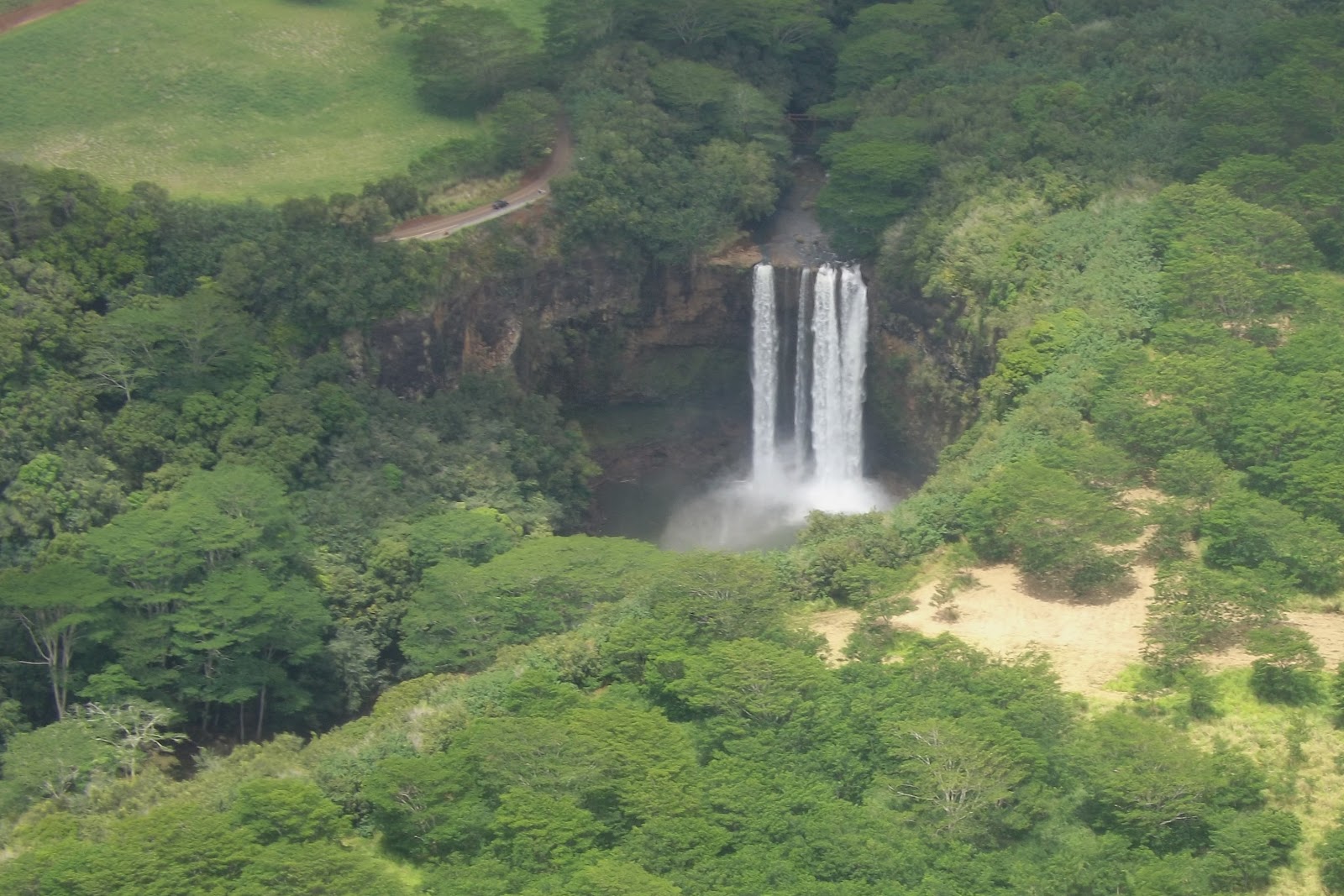
Just the same, we all agreed this view of Wailua Falls was pretty cool.  
     About four miles out of bustling Lihue on a little two lane road, it's a handy breath of nature. 

    The power of water - a beautiful thing to contemplate

NEWS FOR BIRD BRAINS

Aloha - 
          Good news and Bad news from Hanalei wetlands.  The good news is that the bout of avian botulism reported on here recently has ended.  The bad news is that it took out 304 birds.  As mentioned before, the bacteria remains a mystery in many ways but it is believed that the recent floods of early March helped flush the fields.  


Hanalei Valley 


The wetland count (on refuge property) of living birds is as follows:
314 Koloa Ducks
438 Moorhens
641 Hawaiian Coots 
190 Hawaiian Stilts
72 Nene
198 Golden Plover


      The Coot number is probably high because they are about to breed and brought in "extras."   This guy is clearly solo.


 Hawaiian Coot

 Hawaiian Stilts

The Moorhen or Gallinule
        

          The Plovers are about to leave - late April or Early May - to breed in the arctic.  
They will fly 3100 miles in 3 days of non-stop flapping!

 Winter colors


 We know they are leaving when they put on their tuxedos - or travel feathers.  Ooh La La!


Speaking of Nene - we got the estimate for their population recovery.
There are approximately 2500 state-wide and 1500 of those are here on Kauai 


MARCH OCEAN COUNT


 March 31, Saturday
               The ocean count take place the last Saturday of January, February, and March.  The first hour was busy with critters active off shore - remember they are quite a way off shore, picture clarity not so good.         


We saw more breaches than spouts just because the breaches make a bigger splash!   It is hard to see through a squall sitting on the water.

   Splish-splash - this is what 45 tons of displaced water looks like. 
           

Jump for joy?   In a brief moment of sun!


This little guy jumped after Mama did - lessons!

The bulk of our friends (note pun) have left the island but knowing that, we get even more excited to see the ones that arrived late, calved late and are returning to Alaskan waters soon.

We watched the sea rise as we waited in vain for more whale activity
         

  The swells picked up speed and the waves were magnificent 

We don't count waves but we do count seabirds

This Albatross gave everybody a thrill as he flew right over our heads    

Same time, same place next year for the count.